Yehuda Lave is an author, journalist, psychologist, rabbi, spiritual teacher, and coach, with degrees in business, psychology and Jewish Law. He works with people from all walks of life and helps them in their search for greater happiness, meaning, business advice on saving money, and spiritual engagement.
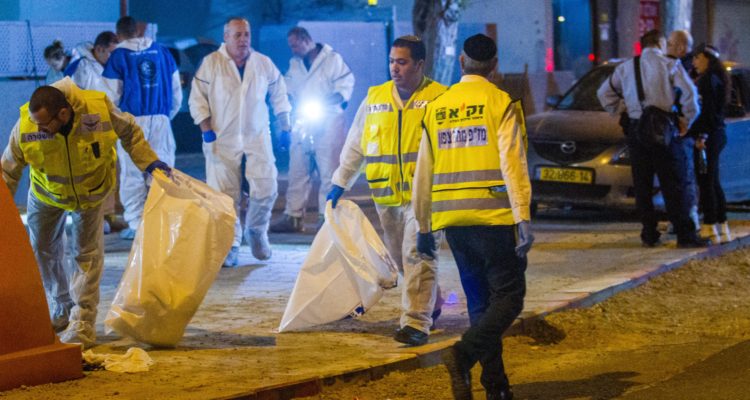
United Hatzalah paramedics at scene of Bnei Brak terror attack.
Five Israelis were reported murdered Tuesday night in a multi-site terrorist shooting attack near Hashnayim Street in the haredi city of Bnei Brak.
Israel Police said the fifth victim was a 32-year-old police officer from the motorcycle team who responded to the attack, and who neutralized the terrorist.
Police Sergeant Major Amir Khoury of Nof HaGalil, an Israeli Christian Arab who served in the motorcycle division at the Bnei Brak precinct, was initially reported in critical condition and evacuated to nearby Beilinson Medical Center. He lost his fight for life shortly after his arrival at the hospital.
Israel Police said notice was given to his family. The hero police officer is survived by his parents, two sisters and a brother.
Two foreign workers and two residents of Bnei Brak were also killed.
The first attack took place on Bialik Street, where three people were shot. The attacker then continued to fire at people on the street, shooting two more people on Herzl Street, on the corner of Jabotinsky. The terrorist began by shooting at drivers in passing cars.
The terrorist, who was riding a motorcycle and using an assault rifle, was reportedly shot and killed on Megadim Street, in nearby Ramat Gan, by a police officer.
First Terrorist Identified The shooter has been identified as Dia'a Hassan Hamarshi, a convicted 27-year-old terrorist from the Samaria town of Ya'bed, who served six months in an Israeli prison in 2013 for membership in a terrorist organization and weapons trafficking, according to Israel's Channel 13 News.
Dia'a was a member of the Fatah-linked Al Aqsa Martyrs' Brigades terrorist organization. Fatah, the leading faction in the Palestinian Authority, is headed by PA leader Mahmoud Abbas.
Dia'a was allegedly working illegally in the area. Given his citizenship, he must have received some type of help in crossing the border into Israel.
Hebrew-language media reported a second suspect was arrested at the scene.
The municipalities of Bnei Brak and Ramat Gan instructed all residents to remain at home "until further notice from the police or the municipality."
Medic Confronted by Terrorist United Hatzalah volunteer EMT Akiva Kauffman said he was riding his emergency e-bike when he heard the gunshots. "I rushed over to the scene and began treating one person in critical condition who was then taken to the hospital."
"Our Psychotrauma and Crisis Response Unit was active at the scene treating multiple people for emotional shock as a result of the shooting incidents," said United Hatzalah volunteer EMT Avi Fishman added.
MDA EMT Menachem Englander who treated the victims of the terror attack, lives on Hashnayim Street, and was at home when the shooting started.
"I immediately went out to the street and saw a terrorist pointing a weapon at me. By a miracle his weapon jammed and he couldn't shoot. I immediately went back in my house, locked my door and reported to the emergency dispatch center.
"Once the police arrived to the scene and cleared it I went back downstairs. Unfortunately, three men in their 30s were unresponsive and suffering from gunshot wounds, and after medical checks, we were forced to pronounce them deceased."
Tensions Skyrocketing Overall, five people were killed, as well as several others suffering from shock. There are conflicting reports if the terrorist is dead and how many terrorists were involved.
Within the past seven days, including Tuesday night's attack, 11 Israelis have been murdered by Arab terrorists — the largest number of victims since a suicide bomber killed 11 people in a 2006 attack on a bus in Tel Aviv.
Local residents swarmed into the streets at the scenes of the attack, with dozens chanting "Bennett Go Home!" Residents were being asked to remain indoors while police search for additional possible terrorists in the area, but many ignored the directive, gathering to express their outrage.
Prime Minister Naftali Bennett met with with Defense Minister Benny Gantz, Public Security Minister Omer Bar Lev, IDF Chief of Staff Aviv Kochavi, Shin Bet director Ronen Bar, Police Commissioner Kobi Shabtai and others for an emergency security consultation.
The full Israeli Security Cabinet is scheduled to meet on Wednesday afternoon.
Land Day on Wednesday The attack comes one day before the so-called "Land Day" commemoration by Arabs in the Palestinian Authority and Gaza, marking the Israeli government expropriation of land in the Galilee on March 30, 1976. Massive riots broke out, leading to the deaths of six Arab citizens by Israeli forces.
Arabs use Land Day to protest not only the government's expropriation of Galilee land, but also to express their rage and hate for the United Nations' designation of land to recreate the Jewish State of Israel. According to the Qatar-based Aljazeera news outlet, "Land Day presents an opportunity not only to mark a past event, but also to think about creative and resilient ways to further resist Israeli land theft."
The Islamic holy month of Ramadan, which begins April 2 this year, is an annual trigger for terrorist violence against the Jewish State.
The Three Musketeers at the Kotel
The Three are Rabbi Yehuda Glick, famous temple mount activist, and former Israel Mk, and then Robert Weinger, the world's greatest shofar blower and seller of Shofars, and myself after we had gone to the 12 gates of the Temple Mount in 2020 to blow the shofar to ask G-d to heal the world from the Pandemic. It was a highlight to my experience in living in Israel and I put it on my blog each day to remember.
The articles that I include each day are those that I find interesting, so I feel you will find them interesting as well. I don't always agree with all the points of each article but found them interesting or important to share with you, my readers, and friends. It is cathartic for me to share my thoughts and frustrations with you about life in general and in Israel. As a Rabbi, I try to teach and share the Torah of the G-d of Israel as a modern Orthodox Rabbi. I never intend to offend anyone but sometimes people are offended and I apologize in advance for any mistakes. The most important psychological principle I have learned is that once someone's mind is made up, they don't want to be bothered with the facts, so, like Rabbi Akiva, I drip water (Torah is compared to water) on their made-up minds and hope that some of what I have share sinks in. Love Rabbi Yehuda Lave.
on the way up to Temple Mount on ides of March
Jerusalem Mayor and Nefesh B'Nefesh Deliver Mishloach Manot to Jerusalem Olim
Photo Credit: Netanel Cohen / Nefesh B'Nefesh
(L-R) Director of the Jerusalem Municipality Authority for Aliyah and Absorption, Pini Glinkewitz; Co-Founder & Executive Director of Nefesh B'Nefesh, Rabbi Yehoshua Fass; NBN Olah and new mom, Rochelle Cohen; Mayor of Jerusalem, Moshe Lion; New NBN Jerusalem Olim, Leslie and Michael Windman with their new granddaughter, Claire.
Moshe Lion, and Co-Founder and Executive Director of Nefesh B'Nefesh, Rabbi Yehoshua Fass, delivered Mishloach Manot (traditional Purim gift baskets) to a three-generation family of new Olim in Jerusalem. The Mishloach Manot consisted entirely of products made by various Jerusalem-based Olim businesses.
The gifts were given to Leslie (59) and Michael (61) Windman, who made Aliyah two months ago from Coconut Creek, Florida to Jerusalem. There, they reunited with their daughter, Rochelle, who made Aliyah as a lone soldier in 2015, as part of the Nefesh B'Nefesh – FIDF Lone Soldiers Program. She fulfilled her military service as a combat engineering instructor, where she met her Israeli born husband, Yehonatan. The couple welcomed their first child, Claire Shoshana, last month.
The Mishloach Manot contained a beer package from BeerBazaar, established by Avi Moskowitz, who made Aliyah from the United States; Hamantaschen from Tzomet HaCupcake, a boutique bakery owned by Ro Oranim, also originally from the United States and fresh ground coffee packages from Power Coffeeworks, founded by Brandon and Stephanie Trigger, originally from South Africa. The products were served on a hand-made ceramic platter from Hadara's Clay Studio, owned by Hadara Rabinowitz who made Aliyah from the United States, and the package was accompanied by festive clown shaped balloons from Jerusalem Balloons, a balloon company for personalized gifts and special occasions, owned by Kate Salasnik, a newcomer from London, UK.
"I was delighted to meet Leslie and Michael Windman, a Jerusalem-based couple, who have quickly adapted to our great city thanks to the support and love that has enveloped them since their arrival. It was extremely exciting for me to meet a three-generation family of Zionists who immigrated to Israel and settled in Jerusalem," said Mayor of Jerusalem, Mr. Moshe Lion. He added that "Last year, 1,322 people immigrated to Israel and settled in Jerusalem, and for that I would like to congratulate all those who work tirelessly to encourage Aliyah, and sincerely hope that at the end of the year we will see even more immigration to the Capital."
"It is extremely fulfilling to meet, together with our dear friend and partner, Mayor Moshe Lion, three generations of Olim who have established their homes in Jerusalem. We are continuously inspired by the dedication of all Olim to the Jewish State and the impact they make daily in every facet of life in Israel, especially in its capital," said Rabbi Yehoshua Fass, Co-Founder and Executive Director of Nefesh B'Nefesh. "It is a true pleasure to meet and offer our appreciation to this inspiring family of Olim and pray together for all Jews worldwide to merit a joyous and peaceful holiday."
Nefesh B'Nefesh, in partnership with the Ministry of Aliyah and Integration, the Jewish Agency for Israel, Keren Kayemeth LeIsrael, and JNF-USA, reports that in 2021, 1,322 new Olim from North America moved to Jerusalem. This is the highest annual figure the organization has recorded in the last three years, in comparison to 877 newcomers in 2019 and 885 in 2020. Jerusalem currently stands as the number one destination for Olim from North America, with the following leading professions: medicine, education, law, sales, and social work.
The Windmans responded to the surprise visit: "It is a pleasure to host and meet in person the Mayor and Rabbi Fass, and we are grateful to both of them for the exciting Purim surprise." They added: "We have always been Zionists and had a strong Jewish home. When we came on a visit to Israel for the first time in 2006, our daughter fell in love with the country and knew she wanted to live here. It was after her service as a lone soldier and our many visits over the years that inspired us to want to live in Jerusalem alongside her. Only after our Aliyah application was in, did we find out she was pregnant. The timing was impeccable and now we feel so blessed to live down the street from our first grandchild in the country's capital."
What Does Extending Daylight Saving Time Mean for the Jews?
On March 12 most of the United States resumed Daylight Saving Time, moving ahead one hour, with plans to resume standard time in November 2022.
The US Senate just voted to extend Daylight Saving Time right through the winter (to take effect in 2023, if it is ratified into law). What does this mean to Jewish people, whose religious routine is linked to the sun (which does not take orders from the Senate)?
The Good News: Shabbat
Well, for many Jews, the greatest challenge is trying to get home from work on Friday afternoons before Shabbat begins, 18 minutes before Sunset.
Until now, at the depth of the winter, this can sometimes be before 4:00 p.m., which was very challenging, especially for those with commutes.
With DST, however, this will be shifted one hour later, so that even on the darkest day of winter, Jews will have one more hour to prepare for Shabbat.
Jews pray three times a day, morning, afternoon and evening. The Amidah (silent prayer) of the morning services should (ideally) be said after the sun has risen.
In January in Detroit, for example, sunrise can be after 8 a.m., which has been challenging for people rushing to get to work, but manageable.
With sunrise now being "delayed" to 9 a.m., Detroit Jews will either need to significantly rearrange their schedules, or rely on halachic leniencies in order to pray earlier. And even those leniencies can only allow them to pray around 7:30 a.m., for example, which will still be challenging for many.
(A minor inconvenience is that the wintertime fast days, which until now have ended before dinner time for many, will now end an hour later).
By Menachem Posner Rabbi Menachem Posner serves as staff editor at Chabad.org, the world's largest Jewish informational website. He has been writing, researching, and editing for Chabad.org since 2006, when he received his rabbinic degree from Central Yeshiva Tomchei Temimim Lubavitch. He resides in Chicago, Ill., with his family
Yehuda Lave is an author, journalist, psychologist, rabbi, spiritual teacher, and coach, with degrees in business, psychology and Jewish Law. He works with people from all walks of life and helps them in their search for greater happiness, meaning, business advice on saving money, and spiritual engagement.
The Three are Rabbi Yehuda Glick, famous temple mount activist, and former Israel Mk, and then Robert Weinger, the world's greatest shofar blower and seller of Shofars, and myself after we had gone to the 12 gates of the Temple Mount in 2020 to blow the shofar to ask G-d to heal the world from the Pandemic. It was a highlight to my experience in living in Israel and I put it on my blog each day to remember.
The articles that I include each day are those that I find interesting, so I feel you will find them interesting as well. I don't always agree with all the points of each article but found them interesting or important to share with you, my readers, and friends. It is cathartic for me to share my thoughts and frustrations with you about life in general and in Israel. As a Rabbi, I try to teach and share the Torah of the G-d of Israel as a modern Orthodox Rabbi. I never intend to offend anyone but sometimes people are offended and I apologize in advance for any mistakes. The most important psychological principle I have learned is that once someone's mind is made up, they don't want to be bothered with the facts, so, like Rabbi Akiva, I drip water (Torah is compared to water) on their made-up minds and hope that some of what I have share sinks in. Love Rabbi Yehuda Lave.
Police chief: Slain police who killed Hadera terrorists prevented mass casualties
Members of the Zaka volunteer organization at the scene of the shooting attack in Hadera, March 27, 2022. (Flash90) Email Print0 Comments
"They planned a much larger killing spree and planned to murder everyone who crossed their path," Police Chief Kobi Shabtai said.
By Batya Jerenberg, World Israel News
Police chief Kobi Shabtai credited the off-duty border policemen who killed two terrorists with preventing a mass casualty event.
Several border police officers were in the vicinity of the bus stop that was the target of terrorist cousins Ibrahim and Ayman Aghbaria, Israeli-Arabs from Umm Al-Fahm. Two 19-year-old off-duty officers, Corporals Yazan Falah and Shirel Abu Karat, were shot as they ran towards the gunfire. Critically injured, they died soon after. Twelve victims were wounded in the attack, some seriously.
Another three officers, members of an undercover unit, were eating nearby and sprinted to the scene. One of them told Channel 12 what happened.
"Two of my men engaged two terrorists," he said, with his back strategically turned to the camera. "I got there a fraction of a second later and saw a terrorist in front of me with a ceramic vest and three magazines, holding an M-16 and firing in the direction of the fighters. I neutralized him.
"At the same time my men were firing at a different angle…. I realized there was another terrorist hiding behind a car, one of the men caught some bullets and fell…. I identified the terrorist, shot and neutralized him."
Four border policemen were injured in the attack in total. Shabtai visited them at Hillel Yafeh Hospital after ordering forces to carry out security sweeps in the region and set up roadblocks, as well as to bring in extra officers to increase the police presence in city centers, Channel 12 reported.
You did the maximum that can be expected of someone in such a situation, which is a matter of seconds," Shabtai told one of the injured.
Bemoaning the "heavy price" of losing two fighters, he told another, "The two came with such an amount of ammunition that if they had not been taken down at that moment, we would have woken up to a different morning in the number of those murdered. They planned a much larger killing spree and planned to murder everyone who crossed their path."
Israelis Discover How Chemotherpy Can Actually Spread Cancer
In some patients, cancer breaks out more aggressively after chemo, even in cases where it successfully shrinks the initial tumor.
The article was chosen as the cover story in Cancer Research.
Prof. Yuval Shaked and doctoral student Jozafina Haj-Shomaly, who led the study, emphasized that existing cancer treatments are highly effective and in many cases save lives.
However, in some patients, the disease breaks out more aggressively after chemo, even in cases where it successfully shrinks the initial tumor.
The researchers focused on the development of metastases in lung tissue following chemotherapy for breast cancer. About 30 percent of patients treated conventionally for early-stage breast cancer develop metastases within a few months or years as cancer cells travel via the lymphatic system to organs such as the lungs, liver and bones.
Shaked's research group discovered in previous studies that LOX, a common enzyme that affects tissue configuration, makes lung tissue more hospitable to cancer cells. Inhibiting the activity of LOX significantly reduces the ability of cancer cells to attach to lung tissue.
The current study found that in response to chemotherapy, high amounts of LOX are secreted from specific immune system T cells.
"Following the changes that the T cells and the LOX enzyme cause in this medium, it begins to help the cancer cells grow, survive, move, divide and cling to each other," said Shaked.
"Moreover, it can block the entry of normal immune cells and even anti-cancer drugs into the malignant region."
Although the study was conducted in a breast cancer model in mice using the chemo drug Paclitixel, the researchers assume their findings will be relevant to other drugs and cancers.
"We were surprised to find that the mechanisms of action we discovered, which encourage the development of cancerous metastases, are activated not only in response to surgeries as previously found, but also in response to chemotherapy and other drugs that we are currently investigating," said Haj-Shomaly.
"Our achievement – the detection of the mechanism that causes a structural change in health by the immune system – may enable the development of combined drugs and treatments that prevent this phenomenon and reduce the chances of developing metastases," said Shaked.
The study was supported by the U.S.-Israel Binational Science Foundation, European Research Council and Israel Science Foundation.
On the coldest day of the year before the fast of Esther (the next day) the Three Musketeers "Storm" (as the Muslims say anyone who goes up to the Temple Mount).
This was our Pre Passover Al Haregel (we are obligated to go to the Temple Mount three times a year on the Hagim) and we showed a friend from Texas his first experience. Coming home the sky was so clear after our hail and light snow that we see the mountains of Jordon from our rooftop. The ides of March 2022
Roman boat that sank in Mediterranean 1,700 years ago gives up its treasures
Finds from fourth-century wreck 'perfectly preserved' just 2m below the surface off one of Mallorca's busiest beaches
Amphorae from the fourth-century AD Roman merchant vessel have been preserved in the sands of the Bay of Palma.Photograph: Jose A Moya/Arqueomallornauta - Consell de Mallorca, Universitat de Barcelona, Universidad de Cádiz, Universitat de les Illes BalearsOne squally day or stormy night about 1,700 years ago, a boat carrying hundreds of amphorae of wine, olives, oil and garum – the fermented fish sauce that so delighted the ancient palate – came to grief during a stopover in Mallorca.
The merchant vessel, probably at anchor in the Bay of Palma while en route from south-west Spain to Italy, was quickly swallowed by the waves and buried in the sands of the shallow seabed.
Until last month, its miraculously preserved treasures had lain untouched, despite sitting just 2 metres beneath the bellies of the countless tourists who swim off one of the busiest beaches in the Balearics.
Now, however, the boat – known as the Ses Fontanelles wreck – is giving up its archaeological, historical and gastronomic secrets. A recovery operation overseen by the island's governing body, the Consell de Mallorca, and involving experts from three Spanish universities in the Balearics, Barcelona and Cádiz, has retrieved about 300 amphorae as well as other objects that offer priceless insights into the Mediterranean of the fourth century AD and the crew's daily lives.
In addition to the clay jars – which still bear their painted inscriptions or tituli picti – archaeologists have found a leather shoe, a rope shoe, a cooking pot, an oil lamp and only the fourth Roman carpenter's drill recovered from the region.
The boat, which is 12 metres long and between 5 and 6 metres wide, emerged three years ago after a summer storm churned up the waters of the bay. Its appearance confirmed anecdotal reports from divers dating back to the 1950s, and prompted the Consell de Mallorca to take action.
After running an emergency intervention, the consell put together a team of archaeologists and marine experts to undertake the three-year Arqueomallornauta project.
"The aim is to preserve everything there and all the information it contains, and that couldn't be done in a single emergency intervention," says Jaume Cardell, the consell's head of archaeology.
"That's where the project Arqueomallornauta comes in: it's about recovering and preserving both the wreck and its historical cargo. This isn't just about Mallorca; in the whole western Mediterranean, there are very few wrecks with such a singular cargo."
Although the team is now looking at how best to recover the hull of the wreck, which lies just 50 metres off the beach, those who brought up the cargo in an operation that ran from November 2021 to mid-February are still a little breathless over what they have found.
None of the team had expected the sands of the bay to have done such a spectacular job of sealing the wreck off from oxygen and preserving its organic materials.
"Things have been so perfectly preserved that we have found bits of textile, a leather shoe and an espadrille," says Dr Miguel Ángel Cau, an archaeologist at the University of Barcelona.
"The most surprising thing about the boat is just how well preserved it is – even the wood of the hull … It's wood that you can knock – like it's from yesterday."
The team, who established that the boat set sail from Spain's Cartagena region by analysing the minerals in the amphorae's clay, say it is hard to overstate the significance of the find.
"It's important in terms of naval architecture because there are very few ancient boats that are as well preserved as this one," says Dr Darío Bernal-Casasola, an archaeologist at the University of Cádiz. "There are no complete Roman boats in Spain."
What's more, he adds, the amphorae represent an improbable subaquatic archaeological hat-trick: "It's incredibly difficult – almost impossible – to find whole amphorae that bear inscriptions, and also still have the remains of their contents. The state of conservation here is just amazing. And you have got all this in just 2 metres of water where millions of people have swum."
For Enrique García Riaza, a historian at the University of the Balearic Islands, the wreck highlights the commercial and strategic importance of the Balearic archipelago during the Roman empire.
"The islands weren't cut off – on the contrary, they were a fundamental staging post on routes from the Iberian peninsula and the Italic peninsula," he says. "In Roman times, the cities of the Balearic archipelago had political elites who were also very well connected to the main Roman cities of the Mediterranean coast, such as Cartagena and Tarragona."
The team has found no trace of the boat's crew apart from their belongings, suggesting perhaps they made it to the shore or were swept away from the wreck by the waves. What they left behind, however, is intriguing.
Cau points to the oil lamp, which bears an obviously pagan symbol of the moon goddess Diana, and to the Christian signs that appear on the seals of some of the amphorae.
"The crew were probably pagan, but some of the merchandise they were carrying has Christian symbols," he says. "You have to be careful about how you interpret that – that cargo could have been from an ecclesiastical authority – but you have that coexistence between the pagan and the Christian.
"That may tell us a bit about the daily lives for the crew. They might have said, 'Look, I'm a sailor and I believe what I believe, but if you want me to carry a Christian cargo, I'm OK with that if the money's good.'"
With the recovery phase complete and the cataloguing under way, thoughts are now turning to putting the entire find on show.
"The idea is to recover the hull, and we are in touch with both national and international experts to make sure it's properly recovered," says Cardell.
"The boat needs to be exhibited and people need to see it. At the end of the day, we do archaeology for everyone and not just for the scientists."
A few weeks after the wreck's cargo was touched by human hands for the first time in almost two millennia, the archaeologists remain buoyant.
"This is one of those finds when you are just laughing all the time because you can't believe it," says Cau. "This is the sort of thing that happens to you once in an academic lifetime. We will never find anything like this again and that's what makes it so special."